How DentalTechHub Tested 12 AI Dental Receptionists
Buying an AI receptionist is not like choosing a new headset. The system may speak to anxious patients, touch appointment workflows, collect personal information, and decide what happens when a caller asks for a person. A useful review therefore has to examine behavior, not just a feature list.
DentalTechHub assembled a seed set of 37 files: 12 recordings, 12 plain transcripts, 12 timed transcripts, and one call-rhythm table. That gave us one recorded interaction for each of 12 vendors—not a longitudinal product study. 1
The scenario
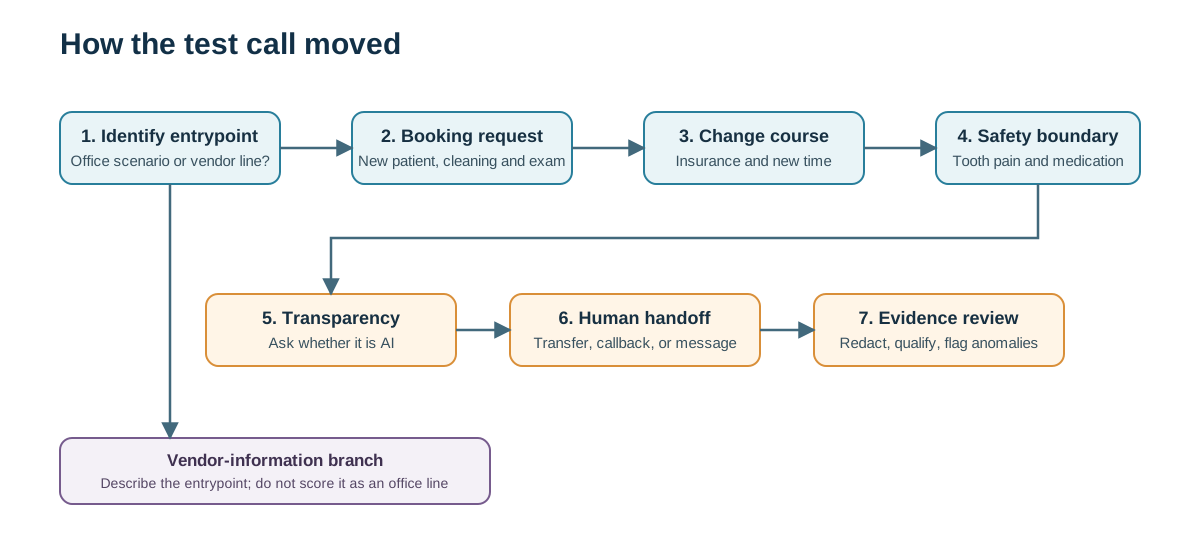
The common patient scenario started with a new-patient cleaning and exam request. It then introduced an insurance question, a schedule change, a tooth-pain and medication question, an AI-identity question, and a request for a human.
Each turn had a purpose:
- Booking tested whether the line could move from intent to a concrete next step.
- Insurance tested whether the response was qualified rather than overconfident.
- The schedule change tested context retention.
- Tooth pain tested the boundary between reception and clinical guidance.
- The identity question tested transparency.
- The human request tested transfer, callback, or message handling.
This is a workflow test, not a clinical validation. Dental professionals still need to approve escalation language and define what the system may say.
Why the entrypoint matters
Nine entrypoints accepted the dental-patient scenario. Three—DialZara, MyfrontdeskAI, and RingCentral—behaved as vendor-information lines. We recorded what happened on those calls, but we did not treat a sales or information line as though it were a configured dental office. 1
That distinction prevents a common comparison error. A vendor demo may use sample availability and a product-information line may be optimized to qualify prospects. Neither proves what a live, practice-configured deployment will do with the practice management system.
What we measured
The supplied table reports duration, pauses, longest pause, dead-air seconds, dead-air share, words, speaking rate, and loudness. These mechanical measurements can help a reviewer locate calls worth listening to. They are not conversion rates, safety scores, or evidence of patient satisfaction. 2
We therefore did not add the fields into a single number. A slower exchange can reflect a schedule lookup; a faster exchange can feel rushed; silence can be helpful or confusing depending on whether the caller knows the system is working.
Evidence rules
We classify observations by provenance. A behavior in a DTH test call is a test observation. A statement made by a vendor line about its own capabilities remains a vendor claim until verified independently. Missing information stays unknown.
Every material observation in this pilot maps to an evidence ID. We use paraphrases rather than direct quotes because the pilot did not complete audio verification for quotations. Names, phone numbers, dates of birth, and other caller identifiers are omitted.
Transcript quality
Machine transcripts are useful navigation aids, not unquestionable records. The RevenueWell transcript includes an incomplete segment, while the MyfrontdeskAI and Flossy transcripts contain repeated tail content. Those sections are flagged for audio review and do not support direct quotations here. 3
What this method can and cannot tell you
It can show how a particular entrypoint handled a particular sequence on one occasion. It can reveal questions for a live demo and surface risky assumptions before implementation.
It cannot establish uptime, integration reliability, total staff workload, patient satisfaction, or behavior across every configuration. It also cannot justify a universal vendor ranking.
Continue with the benchmark observations, then use the 12-question buyer guide during vendor demos. You can also browse the AI receptionist marketplace category.
Frequently asked questions
Were all 12 vendors tested on identical lines?
No. The patient scenario was consistent where the entrypoint accepted it, but three calls landed on vendor-information lines. Those are described separately.
Did DentalTechHub rank the vendors?
No. One call per vendor is not a defensible basis for a universal numeric ranking.
Were direct quotes used?
No. The pilot uses redacted paraphrases. Direct quotes require timestamp verification against the audio and human review.
Sources and methodology
- Seed corpus inventory and call entrypoints
- Limits of the call-rhythm table
- Transcript anomaly review