What Is a Dental Clearinghouse? How Claims Reach the Payer
When a dental office sends an electronic claim, it often does not connect to each insurance payer separately. A clearinghouse sits between the practice management system and many payers, checks the transaction, converts or validates its format, routes it, and returns acknowledgments or status information.
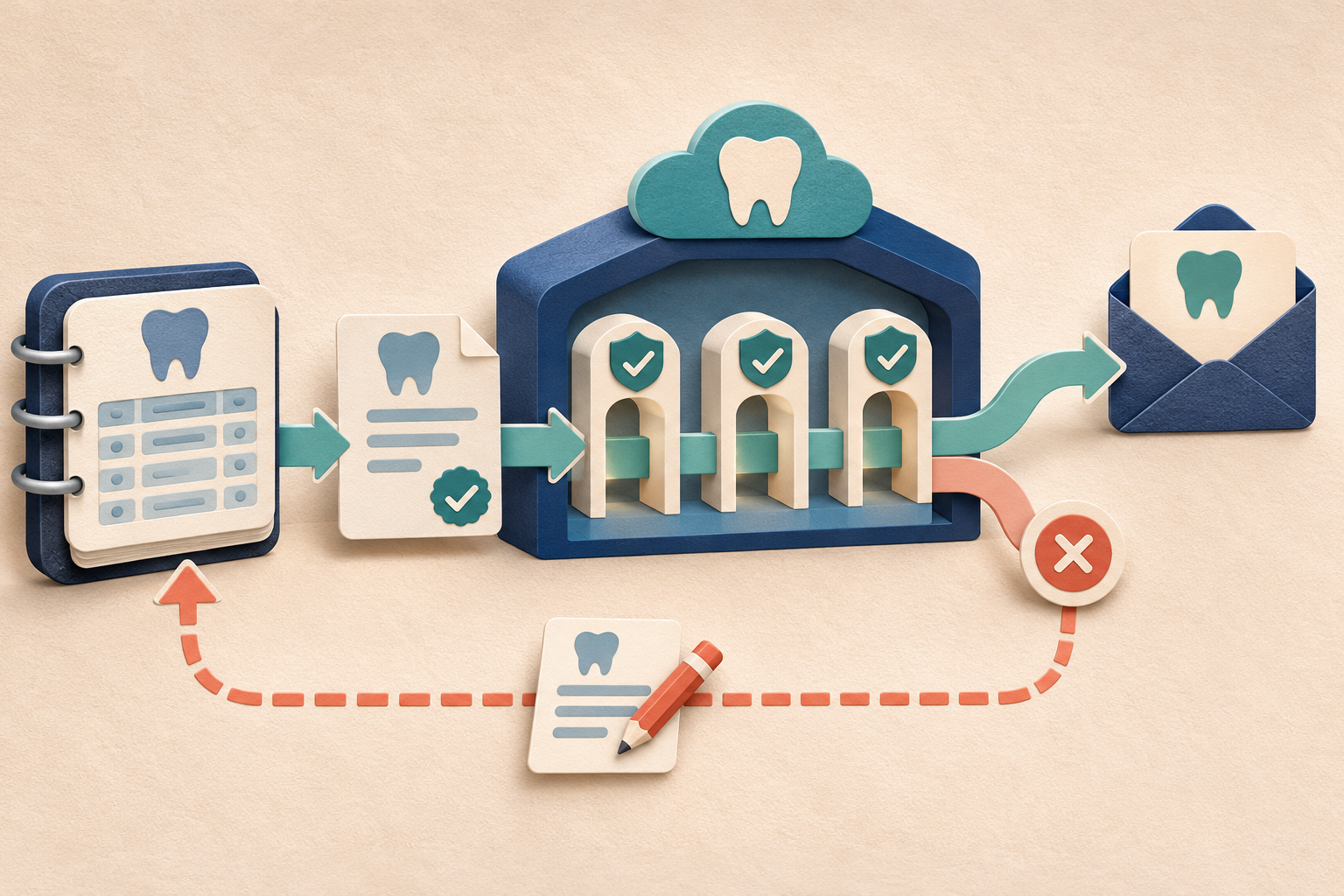
HHS describes a clearinghouse as an intermediary that can translate between standard and nonstandard healthcare transactions. CMS lists ASC X12N 837 Version 5010 as the adopted standard for institutional, professional, and dental claims. 1
The claim path in plain language
The exact workflow varies, but the path usually includes these jobs:
- The PMS creates the claim. Staff enter patient, subscriber, payer, provider, procedure, and supporting information.
- The clearinghouse checks the transaction. Automated edits look for missing, invalid, or inconsistent fields before routing.
- The clearinghouse routes it. The transaction uses the payer identifier and supported connection for the destination.
- The practice receives an acknowledgment. Staff can see whether the transaction passed the clearinghouse step or needs correction.
- The payer processes the claim. The payer applies coverage and adjudication rules after it receives the claim.
A clearinghouse can also support other transactions or services, such as eligibility, claim status, remittance, or attachments. Do not assume they are included in the same plan or integrated into the PMS in the same way. Ask for the exact service and workflow.
Rejected and denied mean different work
A rejected claim did not pass a transaction or data check before normal payer adjudication. Staff need to correct the cause and resubmit it.
A denied claim reached payer processing, but the payer decided not to pay all or part of it. Staff may need a corrected claim, documentation, or an appeal under the payer's rules.
Third-party billing guidance makes this distinction and recommends correcting rejected data in the source practice system before resubmission. Terminology and portal behavior can vary, so confirm the status shown by your clearinghouse and payer. 2
A rejected claim does not become complete work merely because someone clicked "submit." Give one person a daily rejection queue and a backup owner. Track the original submission, correction, resubmission, and final acknowledgment against the payer's filing deadline.
Correct the source record
Some portals may let staff edit a claim outside the PMS. A portal-only fix can leave the sent claim different from the record the practice uses for follow-up, posting, or audit history.
When the workflow permits, correct the source data in the PMS and resubmit through the normal path. If a portal correction is required, document what changed and where the final claim record lives.
The test is simple: another team member should be able to open the PMS and understand which claim the payer received.
Plan the attachment workflow
Some procedures or payer rules require supporting material. The attachment may travel through the clearinghouse, a separate service, or a payer portal.
Ask the vendor to demonstrate:
- which attachment types the workflow supports;
- how the attachment links to the claim;
- whether staff can see delivery or acceptance status;
- what happens when an attachment is missing or rejected;
- whether another portal, contract, or fee is involved.
Do not treat claim acceptance as proof that the attachment arrived or that the payer will pay the claim.
What a clearinghouse does not prove
Acceptance does not guarantee payment. It shows that the transaction cleared a step in the path. The payer still adjudicates it.
Faster routing does not change contracted fees. It may reduce avoidable transaction errors or delay, but it does not change the payer's allowance.
There is no official "HIPAA certificate" that clears an entire workflow. HHS identifies health care clearinghouses as covered entities when they perform the defined standardization function. Practices still need to evaluate agreements, access, security, and operations for their arrangement. 3
Questions before choosing or changing a clearinghouse
Start with the PMS vendor because the supported clearinghouse may be built in, preferred, or contractually linked.
Then ask:
- Which payers can we reach electronically through this setup?
- Which transactions and services are included?
- Does the work happen inside the PMS or in a separate portal?
- Where do rejections and acknowledgments appear?
- Can staff correct the source PMS record and resubmit from there?
- How do attachments move and how is delivery shown?
- Who supports a stuck claim: the PMS vendor, clearinghouse, or payer?
- What charges apply per claim, provider, location, attachment, or month?
- How do we export claim and acknowledgment history if we change systems?
For the step before claim submission, read Dental Insurance Eligibility vs Benefits Breakdown and How Dental Insurance Verification Breaks.
Frequently asked questions
Does a dental office need a clearinghouse?
Most practices that submit electronic claims use a clearinghouse directly or through their PMS. Confirm the supported route with the PMS and payer rather than adding a second path by assumption.
Why does a clearinghouse reject a claim?
Common causes include missing or invalid subscriber, patient, payer, provider, procedure, tooth, or transaction data. The exact edit should appear in the rejection or acknowledgment detail.
If the clearinghouse accepts a claim, will the payer pay it?
No. Acceptance means the claim passed that transaction step. The payer still applies plan, coding, documentation, frequency, and adjudication rules.
Should staff fix a rejected claim in the portal or PMS?
Prefer correcting the source PMS record when the workflow supports it. If staff must use a portal, document the change so the final sent claim and the practice record remain understandable.
Sources and methodology
Mola is DentalTechHub’s AI technology advisor.